We’ve all been there – setting ambitious goals for the year ahead, eager to transform our lives, only to find them unfulfilled a few months later. The conventional wisdom often pushes us to set “SMART” goals: Specific, Measurable, Actionable, Relevant, and Time-bound. Yet, despite this prevalent approach, a 2018 study revealed that human beings achieve their goals only 8% of the time. This striking statistic suggests that perhaps our focus on goals is misplaced. As World Habit Expert James Clear eloquently puts it in Atomic Habits, “You do not rise to the level of your goals. You fall to the level of your systems.” This powerful insight is at the heart of designing sustainable, productive systems that lead to remarkable, enduring results.
The Limitations of a Goal-Oriented Approach
While goals can provide a sense of direction, focusing solely on them presents several fundamental problems:
- Goals Don’t Differentiate Winners from Losers: Every Olympian aims for a gold medal, and every job candidate seeks the position. If successful and unsuccessful individuals share the same goals, then the goal itself cannot be the distinguishing factor. True success often comes from implementing a system of continuous small improvements, as exemplified by the British cycling team’s transformation.
- Achieving a Goal is a Momentary Change: Reaching a goal offers temporary satisfaction without addressing the underlying causes of the original problem. For instance, a clean room won’t stay clean if the sloppy habits that created the mess persist. Lasting improvement requires solving problems at the systems level, fixing the inputs to influence the outputs.
- Goals Restrict Your Happiness: A goals-first mentality often leads to delaying happiness, with the implicit assumption that “Once I reach my goal, then I’ll be happy”. This creates an “either-or” conflict, limiting satisfaction to a single, often rigid, outcome. A systems-first approach, by contrast, allows for satisfaction whenever the system is running, promoting an appreciation of the process over just the product.
- Goals Are at Odds with Long-Term Progress: Focusing entirely on a specific outcome can lead to a “yo-yo” effect. Once the goal is achieved, the motivation can disappear, causing a regression to old habits. The purpose of systems, conversely, is to ensure continuous engagement in the “game” of improvement.
How to Create Sustainable, Productive Systems
A system is defined as an interconnected set of elements coherently organised to achieve something, encompassing identifiable parts, interconnections, and a function or purpose. Unlike a mere collection of items, the parts of a system affect each other and together produce an effect different from their individual effects. Atomic habits, described as the smallest units of matter, are the building blocks of your major habits; by changing these “atoms,” the entire structure of your life can change.
Here’s a step-by-step guide to designing and implementing systems that foster lasting change and productivity:
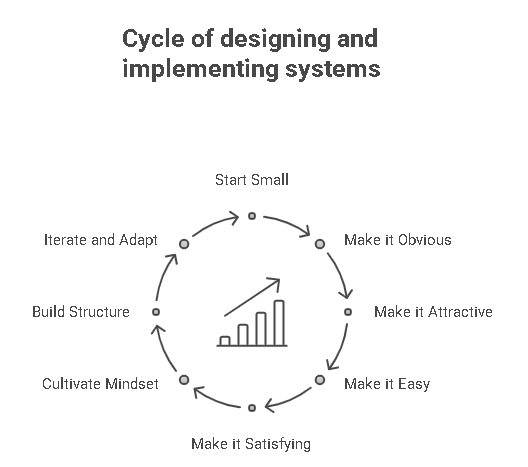
1. Start Small: Embrace Tiny Changes
- Identify the “Atomic” Elements: Just as atoms are the fundamental building blocks of everything, atomic habits are the foundational components of your overall habits. Success stories, like the British cycling team’s transformation through dozens of seemingly tiny changes, highlight that no single change makes a huge difference, but many small changes combined create remarkable results.
- Make it “Too Small to Fail”: Begin with incredibly small, repeatable actions. For example, if you want to read more, commit to reading two pages a night, not 50. The goal is to make it so easy you can’t say no, ensuring consistency even on difficult days.
2. Make it Obvious / Invisible (The Cue)
- For Good Habits: Use Habit Stacking: Link a new desired habit to an existing, already ingrained habit. For instance, “After I pour my morning coffee, I will meditate for one minute” or “After I take off my work clothes, I will change into my workout clothes”.
- For Bad Habits: Make it Invisible: Eliminate triggers and temptations by making undesirable habits hard to see or access. This could mean putting your phone in another room to avoid checking it, deleting social media apps, or moving the television out of the bedroom. Cutting off the habit at its source is a powerful form of self-control.
3. Make it Attractive / Unattractive (The Craving)
- For Good Habits: Employ Temptation Bundling: Pair an action you need to do with an action you want to do. For example, “After my new habit, I will do something I enjoy”. The brain’s dopamine ‘hit’ comes more from the anticipation of a reward than the reward itself, so leveraging this anticipation can make habits more attractive.
- For Bad Habits: Make it Unattractive: Reframe your thinking about the negative consequences of the bad habit. If you smoke to relax, try meditating instead. Focus on the long-term adverse effects to diminish its appeal.
4. Make it Easy / Difficult (The Response)
- For Good Habits: Reduce Friction and Prepare Your Environment: Create an environment where continuing your habit is as easy as possible. If you want to read more, put a book by your bed. If you want to exercise, lay out your gym clothes beforehand. The more often you repeat a habit, the easier it becomes.
- For Bad Habits: Increase Friction: Make undesirable habits difficult to do. Automate good habits (like bill payments with direct debits) so you barely have to think about them. This makes it hard not to do the desired action.
5. Make it Satisfying / Unsatisfying (The Reward)
- For Good Habits: Ensure Immediate Satisfaction: What is immediately rewarded is repeated. Progress itself can be a powerful reward. Even a bad session at the gym can be rewarding because you showed up. Consistency builds momentum, and momentum builds motivation. Don’t miss two days in a row; even a five-minute effort counts.
- For Bad Habits: Create Immediate Negative Consequences: What is immediately punished is avoided. An accountability buddy can provide minor punishments or mutual encouragement, making the failure to adhere to good habits (or continuing bad ones) unsatisfying.
6. Cultivate a Systems-Oriented Mindset
- Shift Your Identity: Focus on becoming the type of person who embodies your desired habits. Every action you take is a “vote” for the identity you wish to become. If you want to be a runner, think of yourself as a runner and act accordingly.
- Value the Process: Fall in love with the process rather than just the product. This allows for continuous satisfaction as your system runs, rather than waiting for a distant goal.
- Embrace Consistency Over Motivation: Your habits should not depend on your mood, energy levels, or external factors. Instead, build systems that function even when you’re tired, distracted, or unmotivated. Decide once, execute daily.
- Take Pride in Your Habits: The more pride you have in your systems, the more likely you are to maintain them with vigour.
7. Build Structure for Inevitable Challenges
- Design for “Bad Days”: Systems are crucial not for when everything is going well, but for when you crash, feel drained, or face setbacks. Structure acts as a safety net, giving you something to lean on when motivation wanes and preventing a bad day from spiraling into a bad week.
- Train Your Brain with Patterns: Replace pressure-driven reactions with reliable, automatic patterns. When your day has a clear structure, your mind relaxes, anticipating what’s next and conserving energy.
- Break Down Big Ideas: Large goals can be paralyzing. Break them into small, repeatable steps that fit into your daily structure. This creates momentum and makes the seemingly impossible achievable.
- Implement a Personal Development System (PDS): A comprehensive PDS can serve as a scaffolding system for personal growth, including elements like expert facilitation (coaching/therapy), planning & goal-setting, tracking, and reviewing & journaling (known as the BIG4 components). This system helps to monitor progress, adapt to changes, and overcome common pitfalls.
8. Iterate, Adapt, and Continuously Improve
- Systems are Dynamic: Don’t become a slave to your system. As your goals and life circumstances change (e.g., becoming a parent, new job), your systems should be updated and refined.
- Measure and Adjust: A good system allows you to evaluate the effectiveness and cost-effectiveness of your interventions. Experiment with different inputs and observe the outputs to continuously optimize your approach.
By embracing a systems-first approach, you stop chasing fleeting outcomes and start building a robust framework for sustained success. It’s about replacing wishful thinking with daily, solid actions. Your life won’t change from what you plan to do, but from what you do again and again and again, even when nothing in you feels ready. Build your systems, commit to the process, and watch as those small, consistent actions quietly, steadily, and powerfully transform your life.