
Struggling to truly understand what you’re learning? The Feynman Technique might be the missing piece in your study strategy. Named after Nobel Prize-winning physicist Richard Feynman, this simple but powerful learning method helps you grasp complex topics faster, retain knowledge longer, and explain things clearly. In this article, you’ll learn the exact steps of the Feynman Technique, how to use it in real life, and where to find resources that support it. Whether you’re a student, professional, or lifelong learner, this method can transform the way you learn.
What is the Feynman Technique?
At its core, the Feynman Technique is based on the idea that if you can’t explain something simply, you don’t understand it well enough. Feynman believed that breaking down a topic and teaching it in plain language reveals the gaps in your understanding—and helps you fix them.
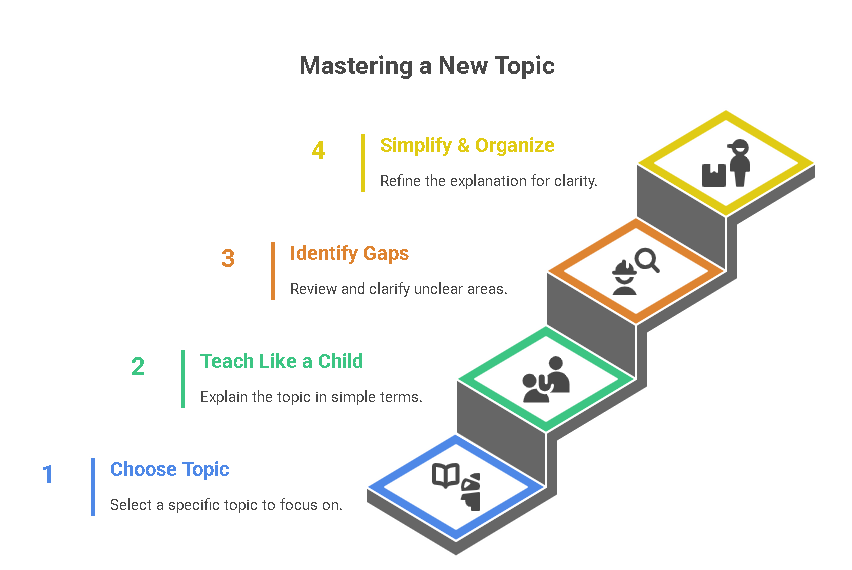
The 4 Simple Steps of the Feynman Technique
Let’s break it down into actionable steps:
Step 1: Choose a Concept You Want to Learn
Pick a topic you’re trying to understand—anything from “Photosynthesis” to “Stock Market Basics” to “Machine Learning Algorithms.”
Step 2: Teach it to a 12-Year-Old
Write down everything you know about the topic as if you were teaching a child. Use simple words and clear analogies. Avoid jargon or complex explanations.
Example:
“A credit card is a small plastic card that lets you buy things now and pay for them later. It’s like borrowing money from the bank. You must pay it back in time, or the bank charges you extra.”
This forces you to simplify your thinking.
Step 3: Identify Gaps and Go Back to the Source
When you get stuck or notice you’re using vague words, circle them. Go back to your source materials—books, videos, notes—and fill those knowledge gaps.
Tip: Don’t just copy definitions. Rephrase everything in your own words.
Step 4: Simplify and Organize
Once you’ve filled in the gaps, rewrite your explanation. Remove any fluff. Create a clean, organized version of your notes that reads like a guide.
- If not, the bank charges “interest.”
- There’s a credit limit, and it affects your credit score.
Why the Feynman Technique Works
- Active Learning: It forces your brain to work with information, not just passively consume it.
- Self-awareness: It reveals what you don’t know, making studying more efficient.
- Knowledge Retention: Teaching locks ideas into long-term memory.
- Confidence Boost: When you can explain something clearly, you truly own it.
Real-World Applications
- Students: Use it to study for exams or presentations.
- Professionals: Prepare for meetings or explain concepts to clients.
- Content Creators: Simplify topics for your audience.
- Job Seekers: Explain resume skills in interview-ready language.
What else can help?
If you’re a visual learner, drawing can amplify the Feynman Technique. Here are a few ideas:
- Draw a flowchart of how a process works (e.g., the water cycle).
- Create a mind map connecting key ideas.
- Design an analogy infographic (e.g., comparing a computer’s CPU to a brain).
These visuals force clarity and help you explain even better.
Using the Technique with Digital Tools
Here are some great tools to implement the Feynman Technique:
- Notion / OneNote: Use pages to break down topics and revise explanations.
- Obsidian: Build a knowledge base and connect ideas like a brain.
- Anki / Quizlet: Turn your “simple explanations” into flashcards.
Related Resources and Books
📘 “Surely You’re Joking, Mr. Feynman!” by Richard P. Feynman
A witty, insightful read into the mind of the physicist behind the method.
📘 “The Feynman Lectures on Physics”
For deeper learners, his lectures model how to explain hard things simply.
📘 “Make It Stick: The Science of Successful Learning” by Peter C. Brown
Provides the psychology behind why techniques like Feynman’s work.
🎥 YouTube: Ali Abdaal’s video on the Feynman Technique
Great breakdowns of how to apply it to studying or self-learning.
📱 Podcast: “The Art of Learning” by Josh Waitzkin
Not about Feynman directly but echoes similar learning principles.
Pro Tips for Maximum Impact
- Practice explaining out loud—even to your dog or your mirror.
- Don’t rush. Learning through this method takes effort, but it’s worth it.
- Try the technique in groups. Teaching peers is highly effective.
- Combine with spaced repetition and retrieval practice for best results.
The Feynman Technique is more than a study method—it’s a mindset shift. By teaching what you learn in simple language, you’ll uncover weak spots, build stronger understanding, and retain knowledge for life. Whether you’re tackling tough subjects or preparing for an interview, this technique offers a clear path to mastery. So next time you’re learning something new, don’t just read it—explain it. That’s the Feynman way.


Pingback: The Difference Between Knowing, Studying,Learning and Understanding - studentsworld.in
Pingback: Smarter Learning with AI: ChatGPT- Your Always-On Study Partner - studentsworld.in