Learning in the Age of AI
“Live as if you were to die tomorrow. Learn as if you were to live forever.” — Mahatma Gandhi
For centuries, learning has followed a familiar pattern: a teacher delivers knowledge, a student receives it, and a textbook provides structure. While this model has served humanity well, it was also limited by time, place, and resources. You could only ask your teacher questions during class hours. Your textbooks couldn’t adapt their explanations to your personal pace. And if you didn’t understand something, your only option was to reread and hope it clicked.
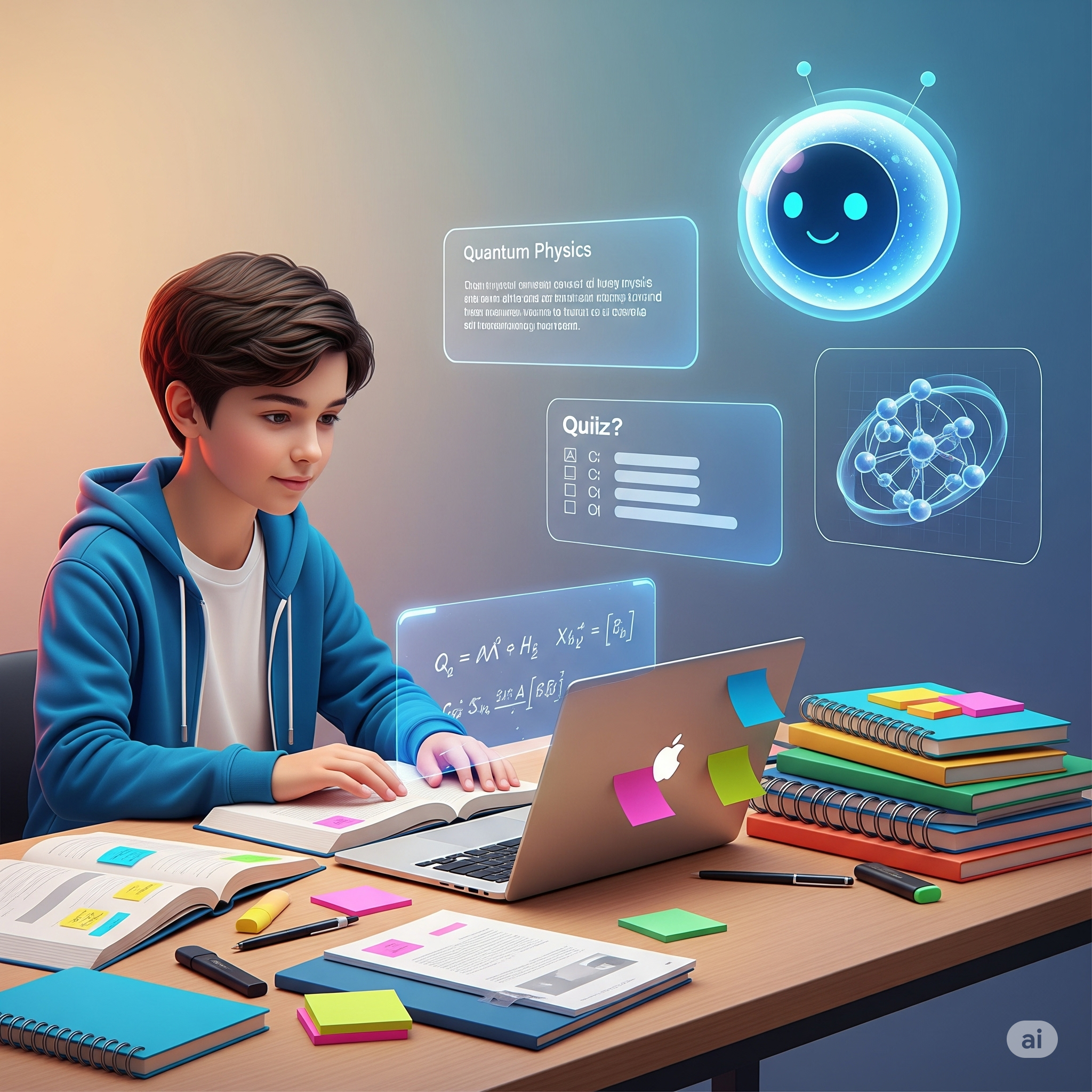
Now, the rules have changed. AI—particularly ChatGPT—has emerged as a 24/7, always-patient study partner. Imagine a tutor who can break down complex theories at 2 a.m., quiz you on yesterday’s lesson, create a customized revision plan for next week’s exam, or summarize a 30-page article in minutes. That’s the new reality.
This chapter is about harnessing that reality. You’ll discover practical ways to use ChatGPT not as a gimmick, but as a strategic tool to learn faster, remember more, and enjoy the process along the way.
The Shift from Passive to Active Learning
Traditional learning often positions us as passive receivers—reading notes, listening to lectures, and reviewing slides. The problem is, passive learning produces shallow understanding. As John Dewey, the father of progressive education, put it: “We do not learn from experience… we learn from reflecting on experience.”
ChatGPT allows you to move into active learning—where you don’t just consume information, but interact with it. You can:
- Question it (“Explain quantum entanglement in the style of a bedtime story”).
- Challenge it (“Give me counterarguments to this theory so I can debate them”).
- Test yourself (“Create a 10-question multiple-choice quiz on the French Revolution”).
By engaging in this dialogue, you’re not only learning faster but also deeper. You’re reinforcing concepts through repetition, reframing, and retrieval—three proven methods for long-term retention.
Breaking Down Complex Topics
“If you can’t explain it simply, you don’t understand it well enough.” — Albert Einstein
Some subjects can feel like locked vaults. You stare at a wall of jargon—thermodynamics equations, legal case summaries, biochemical pathways—and wonder where the key is.
ChatGPT can serve as both translator and guide. For example:
- Ask for Simplification: “Explain the Krebs cycle as if I’m 10 years old.”
- Layer the Detail: “Now explain it at a college biology level.”
- Apply to Real Life: “Give me real-world examples where the Krebs cycle is important.”
This layered approach—moving from simple to complex—mirrors how the brain builds understanding. You start with a conceptual skeleton, then add muscles, then skin.
Personalized Study Plans
A one-size-fits-all syllabus rarely fits anyone perfectly. Some topics you master quickly; others take weeks. ChatGPT can help create adaptive study plans tailored to your pace, schedule, and goals.
Example prompt:
“I’m preparing for the GRE in 3 months. I can study 8 hours a week. Create a weekly study schedule with a balance of quantitative reasoning, verbal reasoning, and analytical writing. Include suggested practice exercises.”
The advantage is flexibility—you can adjust as you go. If you find verbal reasoning easy but struggle with quantitative problems, you can have ChatGPT rebalance your plan instantly.
Summarization and Information Distillation
In an information-rich world, the challenge is not finding knowledge—it’s filtering it. ChatGPT can help you distill key ideas without losing context.
Practical uses:
- Summarize research papers into bullet points.
- Condense a long lecture transcript into a one-page review sheet.
- Extract definitions and formulas from a textbook chapter.
Pair this with active recall—instead of just reading the summary, have ChatGPT turn it into quiz questions so you can test yourself.
Active Recall and Retrieval Practice
“The mind is not a vessel to be filled but a fire to be kindled.” — Plutarch
Studies in cognitive science consistently show that testing yourself is one of the most effective ways to retain information. ChatGPT can automate this by generating practice questions, flashcards, or short-answer prompts on any topic.
Examples:
- “Create 15 flashcards on the causes of World War I.”
- “Make a 10-question quiz on basic Python programming, with answers at the end.”
- “Ask me three progressively harder questions about the Pythagorean theorem.”
This turns studying from a passive review session into a mental workout—strengthening your ability to recall, not just recognize, information.
Combining AI with Proven Learning Techniques
AI is powerful, but its real magic appears when paired with time-tested learning strategies:
- Spaced Repetition: Have ChatGPT schedule quizzes over days or weeks to reinforce memory.
- Interleaving: Mix different subjects in the same session to improve adaptability.
- Feynman Technique: Ask ChatGPT to “play student” so you can explain a concept, then have it point out gaps in your explanation.
- Mind Mapping: Generate a visual outline of a topic’s key points, then explore each branch in depth.
When you combine AI’s adaptability with science-backed learning habits, you accelerate not only speed but quality of learning.
Myths and Misconceptions About Learning with AI
Some people worry that using AI is “cheating” or will make them dependent. In reality, AI is not a shortcut—it’s a multiplier. Like a calculator for math or a search engine for research, it frees your mental energy for higher-level thinking.
Misconceptions to address:
- “It will replace human teachers.” No—it complements them, much like a textbook doesn’t replace a professor.
- “It gives wrong answers sometimes, so it’s useless.” Every tool requires verification. Part of AI literacy is learning to fact-check.
- “It’s only for tech people.” If you can type a question, you can use AI. The key skill is curiosity, not coding.
Actionable Insights & Strategies
Here’s how to start integrating ChatGPT into your learning immediately:
- Begin Every Session with a Question
- Instead of passively reading, ask ChatGPT to guide your exploration.
- Iterate on Explanations
- Start simple, then request more technical detail.
- Convert Notes to Questions
- Feed your notes to ChatGPT and ask for quizzes.
- Mix Formats
- Learn in stories, analogies, diagrams, and bullet points to keep engagement high.
- Plan and Review Weekly
- Use AI to help set goals on Monday and review on Sunday.
Self Assessment / Journal / Reflection Prompt
Prompt: “What is one subject I want to master this year? Write a plan for how ChatGPT could help me learn it faster.”
Think about how you would:
- Break the topic into modules.
- Schedule learning sessions.
- Test your understanding.
- Adjust the plan based on progress.
Learning is no longer limited to classrooms or static materials—AI offers a dynamic, personalized way to master knowledge. By using ChatGPT as a tutor, translator, quizmaster, and planner, you can simplify complex topics, reinforce memory through active recall, and adapt learning schedules to your pace. Myths about AI in education often overlook its potential to amplify—not replace—human thinking. When paired with proven techniques like spaced repetition and the Feynman method, ChatGPT becomes a true “always-on” study partner. The sooner you integrate it into your learning, the sooner you’ll experience both speed and depth in your understanding.
“An investment in knowledge pays the best interest.” — Benjamin Franklin